
ILENE MARTINEZ
Ilene Martinez has spent much of her life learning what it means to belong to more than one place. American by birth, singer and songwriter by vocation, she is also a musician whose artistic identity was profoundly shaped by the years she spent in France. For nearly two decades, she lived, performed and worked among European musicians before eventually returning to the United States. She came back to America carrying something that cannot be packed into a suitcase: another way of hearing. That distance matters. It is one of the reasons Martinez’s music has never fit comfortably inside a single category. Folk, Americana, blues and jazz are all part of her vocabulary, but none of them entirely defines her. Her own description of her music is disarmingly simple: bringing European jazz and American folk together. Yet that simplicity is precisely where her originality begins. Martinez has spent years allowing these traditions to meet without forcing them into a formula, letting them influence one another naturally, as they might when musicians are listening rather than trying to prove a point.
There is an unmistakably American quality to her songwriting. Her songs carry the intimacy and storytelling instinct of folk music, the emotional gravity of the blues and the wide-open spaces of Americana. But there is also something less easily defined, something acquired through years of living outside the musical culture in which she was first formed. Europe gave her distance from the traditions she already knew, and that distance allowed her to hear them differently when she eventually returned. She does not sound like an artist trying to demonstrate that she belongs to a particular musical scene. She sounds like someone who has lived long enough to understand that the most interesting music often begins precisely where categories start to dissolve.
Her voice is central to that impression. It does not demand attention through sheer force, nor does it depend on theatrical gestures. Instead, it draws the listener closer. There is warmth in it, but also a certain fragility, an emotional openness that gives her songs their particular weight. Martinez can sound intimate without becoming confessional, melancholy without becoming defeated, and hopeful without surrendering to easy optimism. Her singing carries the feeling of someone who has learned that vulnerability is not weakness but one of the most enduring forms of musical strength. It is a quality that helps explain why her recordings have resonated so strongly with critics in France, the country that became such an important part of her musical life.
When Reasons appeared in 2019, it was immediately apparent that Martinez was not interested in making a conventional Americana record. The album brought her songwriting together with European musicians including guitarist Olivier Mugot, double bassist Philippe Henner and accordionist Maxime Perrin, with saxophonist Céline Bonacina appearing on two tracks. The instrumentation is largely acoustic, and the arrangements leave considerable space around Martinez’s voice. That restraint became one of the album’s greatest strengths. Rather than filling every measure with sound, the musicians understand the value of silence, of breathing room, of allowing a melody or a vocal phrase to linger for a moment before the next element enters.
Frankie Pfeiffer, editor in chief of Paris-Move, heard in Reasons something larger than a successful encounter between American songwriting and European musicians. He recognized music in which Americana, jazz, blues and folk seem to rub against one another until their borders gradually disappear, leaving behind something freer and more personal. His response was unequivocal: he described the album as “magistral.” Another Paris-Move review made an equally revealing observation about Martinez’s artistic character. She does not impose her talent on the listener. She allows it to unfold. The distinction is important because there is no sense of vocal or instrumental display for its own sake. The musicians serve the songs, and the songs create the space in which her voice can exist. What emerges is not a competition between personalities but a conversation, one in which every musician seems to understand that the most powerful statement may sometimes be the one made by leaving room for someone else.
That approach became even more pronounced on Plume, released in 2024. The story of the album begins in an unusually quiet place. During the Covid lockdowns, Martinez returned to the most elemental combination in songwriting: guitar and voice. She wrote and composed during a period when musicians around the world were being forced into isolation, and the songs that emerged from that experience inevitably carried something of the emotional imprint of confinement, uncertainty and the need to continue creating even when the outside world seemed to have stopped. Yet Plume did not remain a solitary project. What began in the intimacy of guitar and voice gradually expanded into an ensemble recording involving Maxime Perrin and Olivier Cahours, with contributions from clarinetist Samuel Thézé and trumpeter and flugelhorn player Mickaël Gasche. Gasche even brings the unusual sound of the medieval serpent to the record, an instrument whose strange and ancient voice adds another dimension to an album already interested in the meeting of different musical worlds.
These musicians possess considerable technical ability, but virtuosity is never allowed to become the central story. Their role is not to overwhelm Martinez’s songs but to reveal what is already contained within them. Pfeiffer made precisely this point when he observed that the guests complement Martinez rather than attempting to overshadow her. It is a subtle distinction, but it goes to the heart of her musical philosophy. Plume is not built around the idea that more sound necessarily means more emotion. Instead, the arrangements create an atmosphere in which every instrument can appear, disappear and return with a sense of purpose. Jazz enters the music almost like light through a window, illuminating rather than transforming the room. Americana and folk remain at the center, but they are given new colors by musicians who approach them from another tradition.
There is something quietly cinematic about Plume. Its songs seem to move through landscapes rather than simply through chord changes. Melancholy is present, but it is never allowed to become the entire story. The record remembers confinement without becoming imprisoned by it. Beneath its reflective surface is a powerful sense of movement, resilience and release. The title itself seems almost inevitable. What began as a musical life temporarily confined to a room eventually takes flight. The image is simple, but it captures something essential about Martinez’s work: solitude is not necessarily the opposite of collaboration. Sometimes solitude is where a song discovers its first shape, before other voices enter and allow it to become something larger.
Frankie Pfeiffer heard precisely that sense of transformation. His review described Plume as poetic, sensitive and emotionally powerful, an album capable of reaching both the heart and the gut. He ultimately gave it the strongest possible verdict: indispensable. In the 2024 Paris-Move Jazz Awards, Plume was also selected in the Folk category, another indication of the way Martinez’s music can move comfortably between musical worlds without being claimed by any one of them. Yet perhaps the most interesting thing about these distinctions is not the recognition itself but what it reveals about the difficulty of placing her music within a conventional category. She can be heard through the language of folk, blues, Americana or jazz, but none of those descriptions is sufficient on its own.
To understand Ilene Martinez solely through her albums, however, would be to miss half of the story. She is also the CEO of Bayou Blue Radio, and that role is not an afterthought to her career as a musician. It reveals something fundamental about the way she relates to music. Martinez is not interested only in making songs. She is also deeply interested in what happens to music after it is made: who hears it, who discovers it, which artists receive attention and which voices might otherwise disappear beneath the noise of the contemporary music business. Radio gives her another kind of microphone. As a singer, she uses the microphone to tell her own stories. As a broadcaster and curator, she uses it to open a door for other artists. The distinction may seem small, but it changes the nature of her place within the musical community. She is simultaneously creator and listener, artist and advocate.
That dual identity has also brought her into conversations with musicians beyond her own immediate artistic circle. Paris-Move, for example, has published interviews conducted by Martinez through Bayou Blue Radio, including a 2021 conversation with blues artist Mighty Mo Rodgers. There is a natural continuity between these two sides of her life. The same curiosity that leads Martinez to cross musical boundaries as a songwriter also leads her to seek out artists and stories as a broadcaster. She listens with the ears of a musician, but she also listens with the responsibility of someone who understands that independent music depends upon people willing to give it a place, an audience and a chance to be heard.
Perhaps that is why the idea of borders has become so central to her story. Martinez has crossed geographical borders, moving between America and France. She has crossed musical borders, moving between folk, Americana, blues and jazz. She has also crossed the boundary between artist and broadcaster, creating music while helping create an audience for the music of others. None of these crossings feels calculated. They feel lived. That may be the defining quality of Ilene Martinez. There is no sense that she has assembled a collection of influences in order to manufacture an identity. Her identity emerged from experience. The years in France changed the way she heard America. Returning to the United States changed the way she understood the years she had spent away. Making records changed the way she understood the relationship between solitude and collaboration. Her artistic language is therefore not the product of a marketing strategy but of a life lived between places, traditions and communities.
The result is music with a sense of memory, but not nostalgia. Martinez looks backward without becoming trapped there. Her songs carry the weight of experience, but they do not seem interested in romanticizing the past. There is an awareness that music can preserve memory without turning it into a museum piece. Her American roots remain present, but they have been transformed by everything she encountered along the way. This is perhaps what makes her work feel both familiar and unexpected. The listener recognizes the emotional vocabulary of the American songbook, yet something in the phrasing, the arrangements and the spaces between the notes suggests that the music has traveled before arriving here.
There is another quality worth noticing. Martinez’s music does not appear to be driven by the contemporary obsession with polish, branding and instant recognition. Her recordings leave room for breath. Her arrangements allow instruments to disappear and reappear. Her voice is permitted to remain human. The songs do not seem to be asking how quickly they can reach the listener. They are asking whether the listener will stay. That patience may be increasingly rare in an era in which music is often expected to reveal its identity within seconds, but it is also one of the reasons Martinez’s work rewards attention. She understands that intimacy cannot be rushed and that a song does not necessarily become more meaningful because it announces its intentions immediately. Sometimes music has to be given time to settle into the listener.
Ilene Martinez therefore occupies a territory of her own, somewhere between the American troubadour tradition and the European musical sensibility that became part of her life. She is an American artist who learned to hear her own musical roots from a distance and then returned home with that altered perspective. She is a songwriter, but also a witness. A singer, but also a listener. An American artist with a distinctly transatlantic sensibility. And through Bayou Blue Radio, she has become something else as well: a curator of musical voices, a champion of independent artists and a participant in the larger conversation about what music can still mean when it is made for reasons deeper than the marketplace.
Perhaps the best way to describe Ilene Martinez, then, is not by asking where her music belongs, but by asking where it has been. It has been in America and in France, in small rooms and on stages, in solitude and in collaboration, in the quiet intimacy of a guitar and a voice and in the fuller sound of musicians responding to one another. It has traveled across an ocean without ever abandoning the place from which it began. It has absorbed another culture without pretending to become something else. And now it lives somewhere in between, in that fertile territory where identity is no longer a matter of choosing one side or the other but of allowing both worlds to speak at once.
That place has no official name, and perhaps it does not need one. Ilene Martinez has made it her own.
Musicians on Saint PLUME’s album
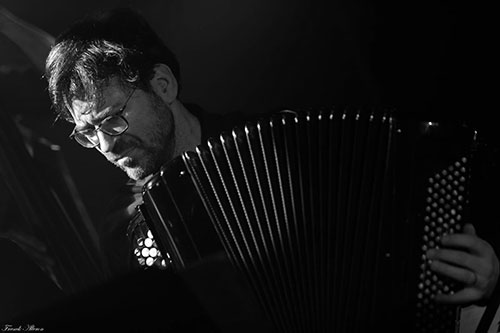
Maxime Perrin
Parisian accordionist and composer Maxime Perrin’s individualistic style has evolved naturally from years of experience in a wide variety of genres: orchestrated jazz, gypsy folk, rock and urban. A highly polyvalent musician, Maxime regularly accompanies theater, improv and one-man shows, when not on the road with his own music.
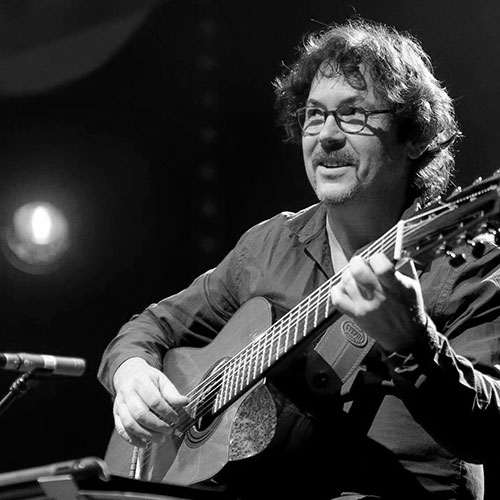
Olivier Cahours
Parisian world jazz music guitarist and recording artist, he has travelled to every continent with his compositions. As a side man, he has worked with top world music artists like Richard Bona, Ibrahim Maalouf and Manu Codjia
Special guests
Samuel Theze
Parisian guest artist on bass clarinet; plays in classical and jazz ensembles in France (including a duo with the accordionist on this album, Maxime Perrin)
Mickael Gasche
On trumpet, flugelhorn and serpent. Recording artist from Le Mans, recorded trumpet, flugelhorn and serpent on Elvis Costello’s album “Hey Clockface” (2020)
Thierry De Clemensat
Producer, writer, singer, and artistic director since the late 1970s, in Paris, Brussels, and beyond.
Musicians on Reasons
Maxime Perrin
(see biography under Saint Mars)… Also on French horn
Olivier Mugot
Music professor at the conservatory in Auxerre (Burgundy, France), he is a composer and recording artist, working with several jazz and blues groups, and has played at festivals across France.
Philippe Henner
Chief collaborator of Olivier Mugot, he has worked with well-known French blues artists as well, such as Nina Van Horn.
Special Guest
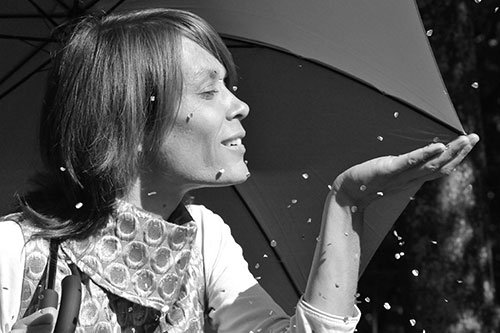
Celine Bonacina
Voted “rising star” of the baritone sax this year and for the last few years in Downbeat magazine. She has released several albums on the prestigious German jazz label “Act” and is now with Crystal Records in France.
She has played at all the most important jazz festivals in France (like Jazz in
Vienne, Jazz in Marciac, etc) and at festivals across Europe. Last year, she was named a Chevalier des Arts et des Lettres by the French Cultural Minister, along
with the other members of the Rhoda Scott’s (Ray Charles’ former keyboardist)
Lady All-Stars band.
Her world-music groove comes from having spent several years living on Reunion Island, and recording her first (independent) album with local musicians there.